Image Restoration#

Here, we provide some examples to solve a variety of image restoration problems in only a few lines of \(\nabla\)-Prox code.
[1]:
# uncomment the following line to install dprox if your are in online google colab notebook
# !pip install dprox
[2]:
from dprox import *
from dprox.utils import *
from dprox.contrib import *
Deconvolution#
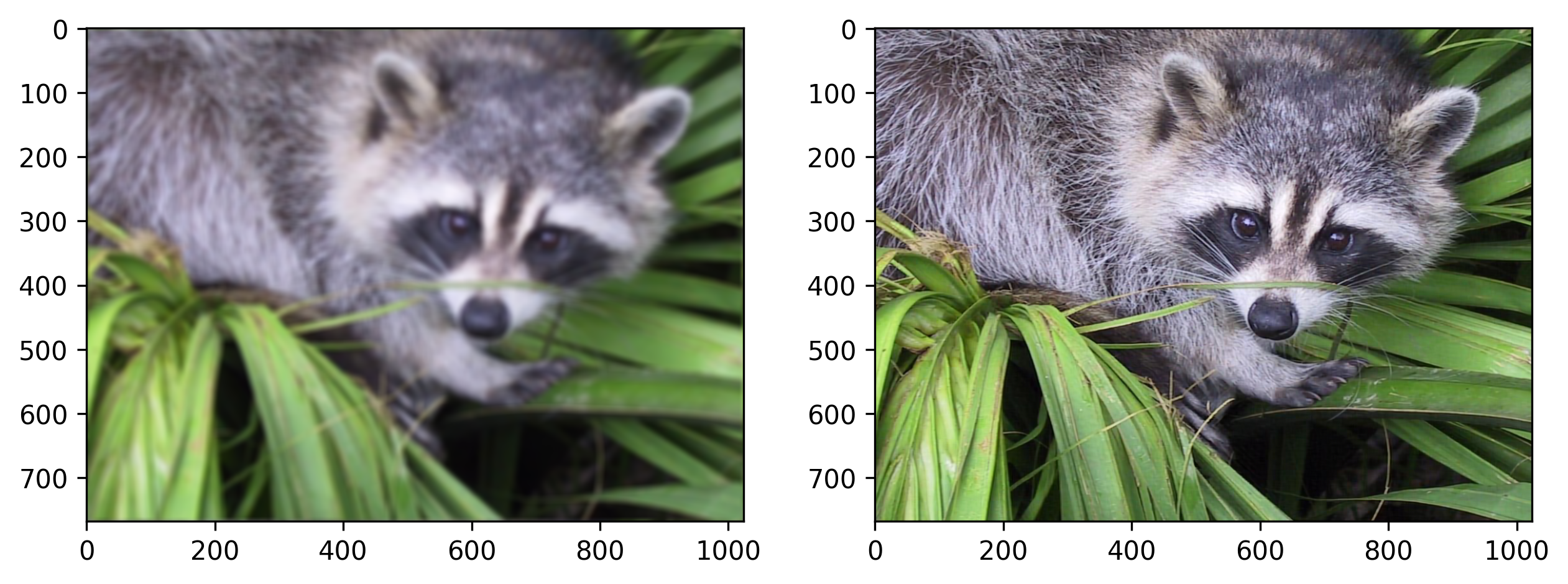
Image deconvolution is the process of recovering a sharp image, \(x\), from a blurred and noisy observation, \(y\), using a mathematical model of the blurring process. The observed image can be modeled as the convolution of the true image with a blurring kernel, \(h\):
where * denotes the convolution operation.
[3]:
img = sample('face')
psf = point_spread_function(15, 5)
b = blurring(img, psf)

x = Variable()
data_term = sum_squares(conv(x, psf) - b)
reg_term = deep_prior(x, denoiser='ffdnet_color')
reg2 = nonneg(x)
prob = Problem(data_term + reg_term + reg2)

max_iter = 24
rhos, sigmas = log_descent(35, 30, max_iter)
out = prob.solve(method='admm', x0=b, pbar=True)

print(psnr(out, img))  # 31.50
imshow(b, out)
100%|██████████| 24/24 [00:01<00:00, 15.97it/s]
34.51118052292636
Demosaicing#
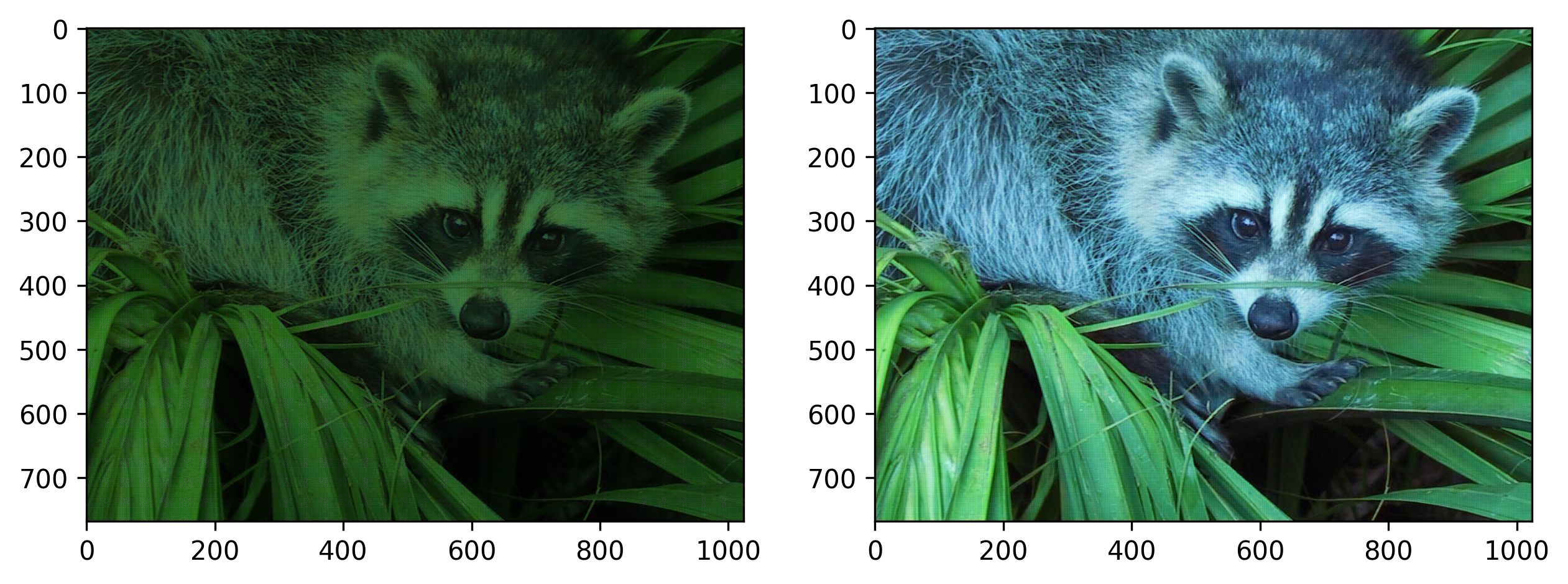
Image demosaicing is the process of reconstructing a full-color image from a partially sampled version captured by a color filter array (CFA). A CFA is a patterned color filter placed over the image sensor in a digital camera, where each pixel only captures a single color component (e.g., red, green, or blue).
[4]:
img = sample('face')
b = mosaicing(img)

x = Variable()
data_term = sum_squares(mosaic(x) - b)
reg_term = deep_prior(x, denoiser='ffdnet_color')
prob = Problem(data_term + reg_term)

max_iter = 24
rhos, sigmas = log_descent(35, 30, max_iter)
out = prob.solve(method='admm', x0=b, rhos=rhos, lams={reg_term: sigmas}, max_iter=max_iter, pbar=True)

print(psnr(out, img))  # 39.027
imshow(b, out)
100%|██████████| 24/24 [00:00<00:00, 31.48it/s]
16.305765918626687
Joint Demosaic and Deconvolution#
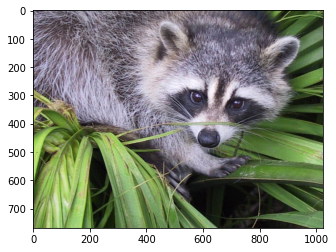
Joint demosaicing and deconvolution is a technique for simultaneously recovering a full-color image from a color filter array (CFA) and deblurring the image to reduce the effects of blur and noise.
[5]:
img = sample('face')
img = to_torch_tensor(img, batch=True).float()
psf = point_spread_function(15, 5)
b = blurring(img, psf)
b = mosaicing(b)

x = Variable()
data_term = sum_squares(mosaic(conv(x, psf)) - b)
reg_term = deep_prior(x, denoiser='ffdnet_color')
prob = Problem(data_term + reg_term,
                linear_solve_config=linalg.LinearSolveConfig(max_iters=500))

max_iter = 24
rhos, sigmas = log_descent(35, 30, max_iter)
out = prob.solve(method='admm', x0=b, rhos=rhos, lams={reg_term: sigmas}, max_iter=24, pbar=True)


imshow(out)
print(psnr(out, img)) # 29.689
0%| | 0/24 [00:00<?, ?it/s]100%|██████████| 24/24 [05:13<00:00, 13.06s/it]
20.942818716367416
Super-Resolution#
Image super-resolution is the process of recovering a high-resolution image from the low-resolution image.
[6]:
img = sample('face')
psf = point_spread_function(5, 3)
y, x0 = downsampling(img, psf, sf=2)

x = Variable()
data_term = sisr(x, y, kernel=psf, sf=2)
reg_term = deep_prior(x, denoiser='ffdnet_color')
prob = Problem(data_term + reg_term)

max_iter = 24
rhos, sigmas = log_descent(35, 35, max_iter)

out = prob.solve(method='admm', x0=x0, rhos=rhos, lams={reg_term: sigmas}, max_iter=24, pbar=True)

print(psnr(out, img))  # 33.518
imshow(out)
100%|██████████| 24/24 [00:00<00:00, 53.27it/s]
32.901809404150306